From Black Power to Hip Hop: Racism, Nationalism, and Feminism (Politics History & Social Chan) by Patricia Hill Collins
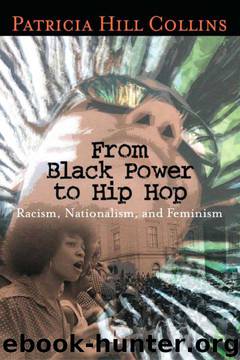
Author:Patricia Hill Collins
Language: eng
Format: epub
Published: 2010-08-07T16:57:00+00:00
The Changing Contours of Black Women's Community Work
Within the rights-based, individualistic assumptions of Western feminism, Mrs. Hamer's statement, "I'm not hung up on this liberating myself from the black man, I'm not going to try that thing," seemingly lacks feminist consciousness and demonstrates political naivete.10 Yet Mrs. Hamer was far from naive, and her politics might he better understood within the context of Black women's community work. As mothers, wives, and churchwomen, African American women such as Mrs. Hamer have long assumed responsibility for maintaining Black community institutions that shield Black children from and prepare them for the poor treatment afforded Black people in America. Black women participated in community development activities on behalf of future generations, just as prior generations had labored for them. Historically, many women approached their families, churches, and communities as important and valued members of Black civil society. As illustrated by the case of African American churchwomen, when challenged by their churches, many women respond, "If it wasn't for the women, you wouldn't have a church."11
Whether in the South or the North, growing up under racial segregation meant that African American women such as Hamer, Bambara, and Cleage came to political struggle both as unique individuals and as members of a historically constituted, oppressed racial group. Prior to the racial desegregation that gathered momentum after the passage of civil-rights legislation in the 1960s, it was virtually impossible for African American individuals to grow up without knowing that they were Black and what that meant in America. Historical legacies of group-based oppression such as slavery, colonialism, and racial segregation stimulated group-based collective identity politics crucial to struggles against racism. For example, in her study of African American political life in the transition from slavery to freedom, the historian Elsa Barkley Brown examines the distinctive dynamics of this orientation toward racial-group membership in Richmond, Virginia:
Download
This site does not store any files on its server. We only index and link to content provided by other sites. Please contact the content providers to delete copyright contents if any and email us, we'll remove relevant links or contents immediately.
| Anthropology | Archaeology |
| Philosophy | Politics & Government |
| Social Sciences | Sociology |
| Women's Studies |
Nudge - Improving Decisions about Health, Wealth, and Happiness by Thaler Sunstein(7707)
The Fire Next Time by James Baldwin(5446)
iGen by Jean M. Twenge(5416)
Adulting by Kelly Williams Brown(4574)
The Sports Rules Book by Human Kinetics(4386)
The Hacking of the American Mind by Robert H. Lustig(4383)
The Ethical Slut by Janet W. Hardy(4253)
Captivate by Vanessa Van Edwards(3839)
Mummy Knew by Lisa James(3691)
In a Sunburned Country by Bill Bryson(3542)
The Worm at the Core by Sheldon Solomon(3487)
Ants Among Elephants by Sujatha Gidla(3467)
The 48 laws of power by Robert Greene & Joost Elffers(3291)
Suicide: A Study in Sociology by Emile Durkheim(3022)
The Slow Fix: Solve Problems, Work Smarter, and Live Better In a World Addicted to Speed by Carl Honore(3009)
The Tipping Point by Malcolm Gladwell(2922)
Humans of New York by Brandon Stanton(2873)
Get What's Yours for Medicare: Maximize Your Coverage, Minimize Your Costs by Philip Moeller(2732)
Handbook of Forensic Sociology and Psychology by Stephen J. Morewitz & Mark L. Goldstein(2705)
